
Sigma Metric Analysis
A LOCMEDT C200 in Indonesia
A paper demonstrates the performance of a new instrument, the LOCMEDT C200. The data is less than compelling.
A LOCMEDT C200 in West Java, Indonesia
June 2026
Sten Westgard, MS
[Sigma score: controls near decision points: +0.5; Final Score: 1. Possibly Misleading. ]
A recent study looked at the LOCMEDT C200 analyzer performance at a laboratory in West Java, Indonesia:
Performance Verification of the LOCMEDT C200 Automatic Biochemistry analyzer Using Routine Clinical Samples, Abas Suherli, Anjas Wilapangga. Journal Syifa Sciences and Clinical Research (JSSCR), Volume 8, Numbe 2, 2026. Https://doi.org/10.37311/jsscr.v8i2.37251
This is a new analyzer to our eyes, we have not heard of it before. It's intriguing to see what a new instrument from a new company can do. Unfortunately, the analysis is not optimistic.
"The LOCMEDT C200 Automatic Biochemistry Analyzer is a newly introduced analytical system intended for routine clinical chemistry testing....[I]ndependent verification under routine laboratory conditions remains necessary before the system can be adopted for clinical use.... At present, published evidence regarding the independent analytical performance verification of the LOCMEDT C200 using routine clinical samples remains limited."
The study applied the 1992 CLIA goals to assess performance. We're going to apply the more modern CLIA 2025 quality goals to see what the analytical Sigma metrics could be.
Calculating Sigma metrics from routine laboratory performance data.
The imprecision and bias of the analyzers
"Precision verification was conducted using internal quality control (IQC) material at a clinically relevant concentration level. Precision was assessed using a modified CLSI EP15-A3 design....For btween-day precisino, the control material was analyzed in triplicate per day for five consecutive days. Precision was expressed as the coefficient of variation (CV%), and the observed values were evaluated against manufacturer claims and CLIA [1992] allowable performance limits."
"Analytical accuracy was assessed using 40 residual patient serum samples representing clinically relevant concentration ranges for each analyte. All samples were analyzed in duplicated on both the LOCMEDT C200 and the reference analyzer in accordance with CLSI EP09-A3 recommendations....For bias estimation, the assigned target value for each analyted was defined as the mean result obtained from the reference analyzer (Indiko), and the percentage bias was calculated as the relevant differencebetween the mean value generated by the LOCMEDT C200 and the corresponding mean target value from the reference method. Bias acceptability was interpreted using [1992] CLIA total allowable error (TEa) criteria."
| LOCMEDT C200 assay | TEa Source | TEa | Lab Mean | % Bias | SD | % CV | Sigma |
| Albumin | CLIA 2025 | 8 | 4.37 | 5.12 | 0.32 | 7.32 | 0.39 |
| Alk Phos | CLIA 2025 | 20 | 200.45 | 4.05 | 17.86 | 8.91 | 1.79 |
| ALT | CLIA 2025 6 U/L or 15% |
16.5 | 36.4 | 11.30 | 4.16 | 11.43 | 0.45 |
| AST | CLIA 2025 6 U/L or 15% |
19.0 | 31.55 | 32.30 | 3.95 | 12.52 | negative |
| Bilirubin, Total | CLIA 2025 0.4 mg/dL or 20% |
20 | 2.13 | 9.82 | 0.23 | 10.80 | 0.94 |
| Cholesterol | CLIA 2025 | 10 | 177.2 | 22.32 | 14.32 | 8.08 | negative |
| Creatinine | CLIA 2025 0.2 mg/dL or 10% |
15.2 | 1.32 | 7.07 | 0.13 | 9.85 | 0.82 |
| GGT | CLIA 2025 5 U/L or 15% |
15 | 49.9 | 6.00 | 4.93 | 9.88 | 0.91 |
| Glucose | CLIA 2025 6 mg/dL or 8% |
8 | 113.6 | 3.58 | 8.48 | 7.46 | 0.59 |
| HDL | CLIA 2025 6 mg/dL or 20% |
20 | 62 | 1.85 | 6.53 | 10.53 | 1.72 |
| Protein, Total | CLIA 2025 | 8 | 6.27 | 1.36 | 0.5 | 7.97 | 0.83 |
| Triglycerides | CLIA 2025 | 15 | 115.6 | 7.28 | 9.57 | 8.28 | 0.93 |
| Urea Nitrogen | CLIA 2025 2.0 mg/dL or 9% |
9 | 44.23 | 4.06 | 2.79 | 6.31 | 0.78 |
| Uric Acid | CLIA 2025 | 10 | 5.74 | 7.67 | 0.63 | 10.98 | 0.21 |
None of these numbers are above 3 Sigma, which is considered the minimum acceptable performance by traditional Six Sigma standards.A few of them are negative, which means the bias is actually larger than the TEa goal itself. At that point, the number doesn't matter, the method is simply aiming at the wrong target.
Graphic illustration of analytical performance by NMEDx chart
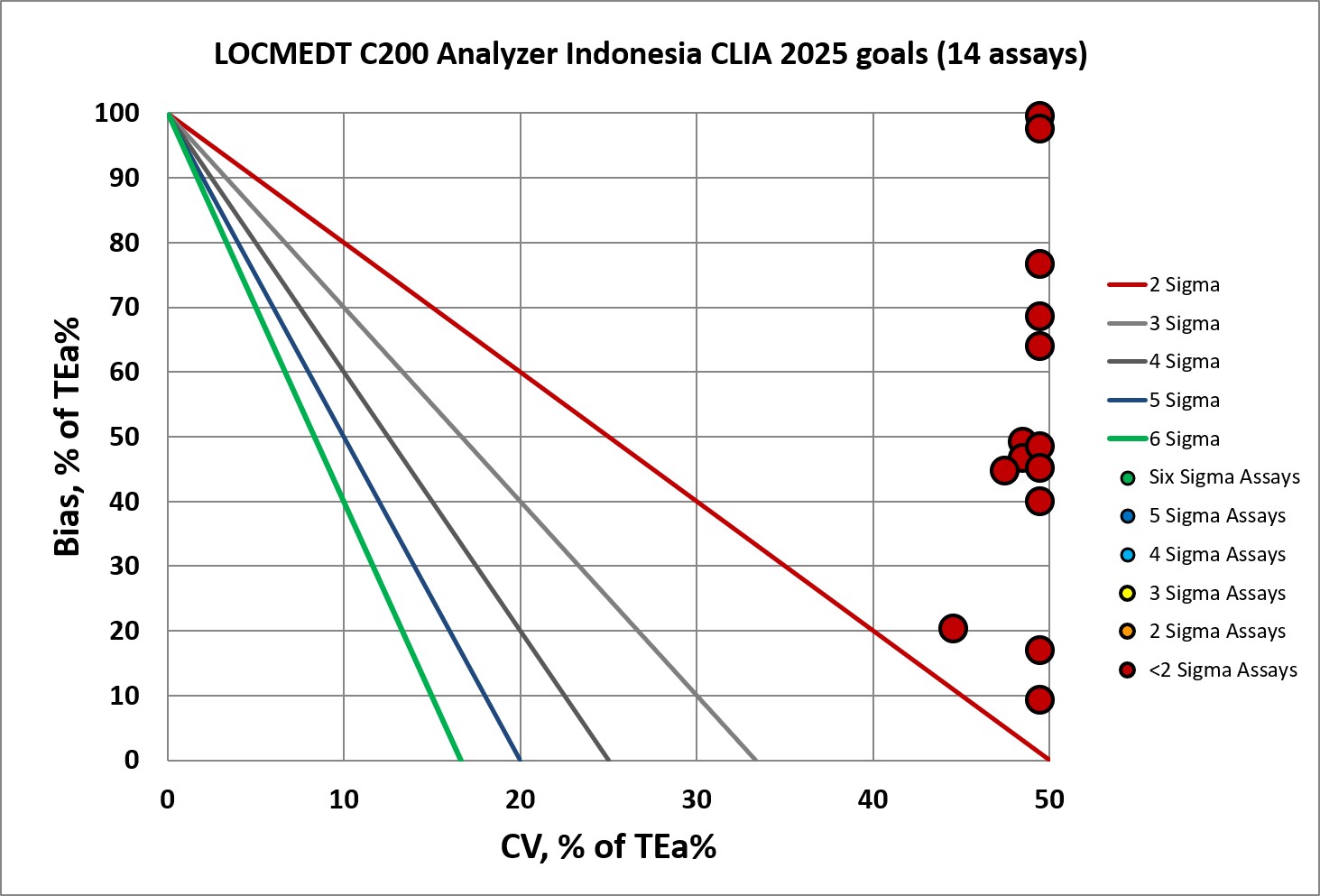
This is not good. This is not even bad. This is really bad. Apply CLIA 2025 standards and none of the methods achieve even 2 Sigma, much less 3 Sigma, which is generally considered the minimum acceptable performance by traditional Six Sigma directives.
Furthermore, 7 of 14 methods do not even meet the manufacturer claims for imprecision. The between-day imprecision is in excess of these claims. Regardless of the TEa goals applied, this instrument is not operating as it is supposed to perform.
Conclusion
The authors concluded, "[o]verall, the analyzer demonstrated acceptable analytical performance for most routine chemistry parameters, indicating that it can support routine laboratory service under appropriate quality assurance conditions." But that was under the previous century standards (CLIA 1992).
When we apply the goals of this century (CLIA 2025), we find there are no analytes that meet acceptable performance standards. If this instrument is put into routine use, the results would need to be carefully handled so that the noise of the method could be separated from the true signal of the patients.
This is one snapshot of the C200. AS the authors noted, there are very few studies in the literature about this instrument. Perhaps other studies will show better performance. But in the face of these results, caution is very much warranted.