
"Real" analytical Sigma metrics, a rarity
[Full disclosure, Westgard QC has a partnership with Beckman Coulter. However, this paper was not prepared by Westgard, but was written completely independently. We are simply calling attention to the study's unique approach and findings.]
A new study from Tamil Nadu, India, has gone into unprecedented detail of the analytical performance. Typically we see metrics collected and determined for a lot of pre-analytical and post-analytical processes, and then a smattering of analytical processes. Often the only analytical Sigma metric is the one calculated from QC performance data.
This study went deep into the details of analytical performance:
From calibration to confidence: Evaluating the Beckman Coulter AU 700 through real-world sigma performance metrics. Jayesh Prabhakar Warade. International Journal of Clinical Biochemistry and Research 2025;12(2):78-83. https://doi.org/10.18231/j.ijcbr.v.12.i.2.3
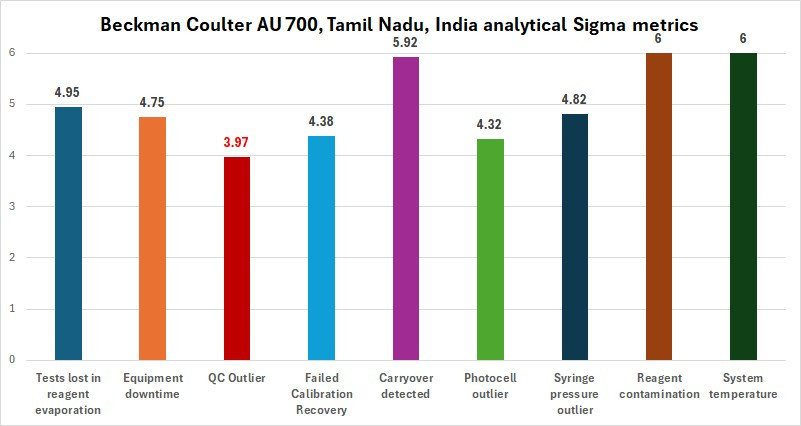
The study looked at 6 months of performance (May 2023 through October 2023) of an AU 700 at Meenakshi Labs, Madurai, Tamil Nadu, India. The analytical Sigma metric from QC performance was calculated, following the Westgard equation. All other metrics were counted, converted from %error into DPM, and from there a table look up gives the short-term Sigma metric.
The IQC performance is not reported here on a test by test basis, but instead for the instrument as a whole, an unusual approach. We are reaching out to the author to see if more granular detail is available, and in particular, what TEa goals were used to calculate the Sigma metrics.
This is the first study we've seen that looks into such details as equipment downtime, carryover, photocell outliers, etc. What's noteworthy is that all the mechanical processes are good, great, or even world class. The worst process is QC. So mechanically the instrument is functioning great. But some assays may not be fit for purpose, because even when they are working perfectly to design, that level of quality may not achieve the quality needed for patient diagnosis and treatment. We don't know what assays are good or bad, because it's all lumped together. We really need to see the test by test performance.
Stay tuned...
Stay Informed
When you subscribe to the blog, we will send you an e-mail when there are new updates on the site so you wouldn't miss them.

Comments